DICK NUNN
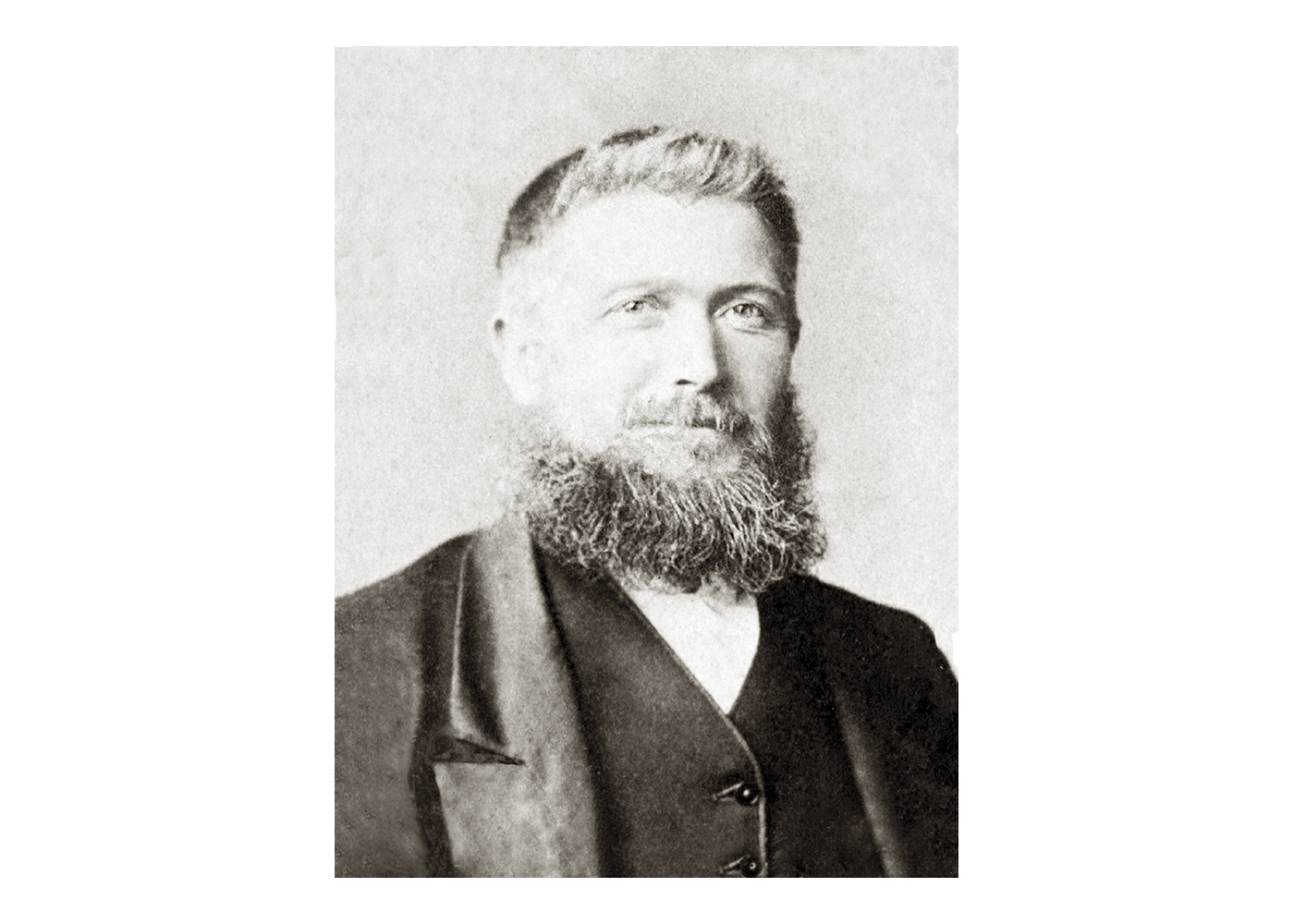
Henry Nunn—known to everyone simply as Dick—was, by all accounts, a bit of a lad. He was born in 1836 on Coggeshall’s Rotten Row. When Dick was just two years old, his mother died, but even in childhood he showed a stubborn resilience and a quiet confidence that would serve him well.
Blacksmithing was the family trade, passed down through the generations, and from an early age it was clear that Dick would follow the same path. Apprenticed to his father, he learned the rhythms of the forge and the weight of responsibility that came with it. But fate intervened before his training was complete. His father died of tuberculosis—then a common and deadly illness—leaving the family suddenly without its anchor.
At just eighteen, Dick stepped out of apprenticeship and into manhood. With his family depending on him, he took up the hammer in earnest.
Dick was a man of strong opinions —a born campaigner with an unshakable belief in fairness and a fierce loyalty to the working people of Coggeshall. He also had an impish sense of humour and a love of good company.
In the 1850s Coggeshall was one of the most industrialised towns in Essex but the 1880s the town was in visible decline and the population fell by a third. Cottages stood empty and crumbling, left to rot by their owners. To Dick, this was more than carelessness; it was an insult to the town and its people.
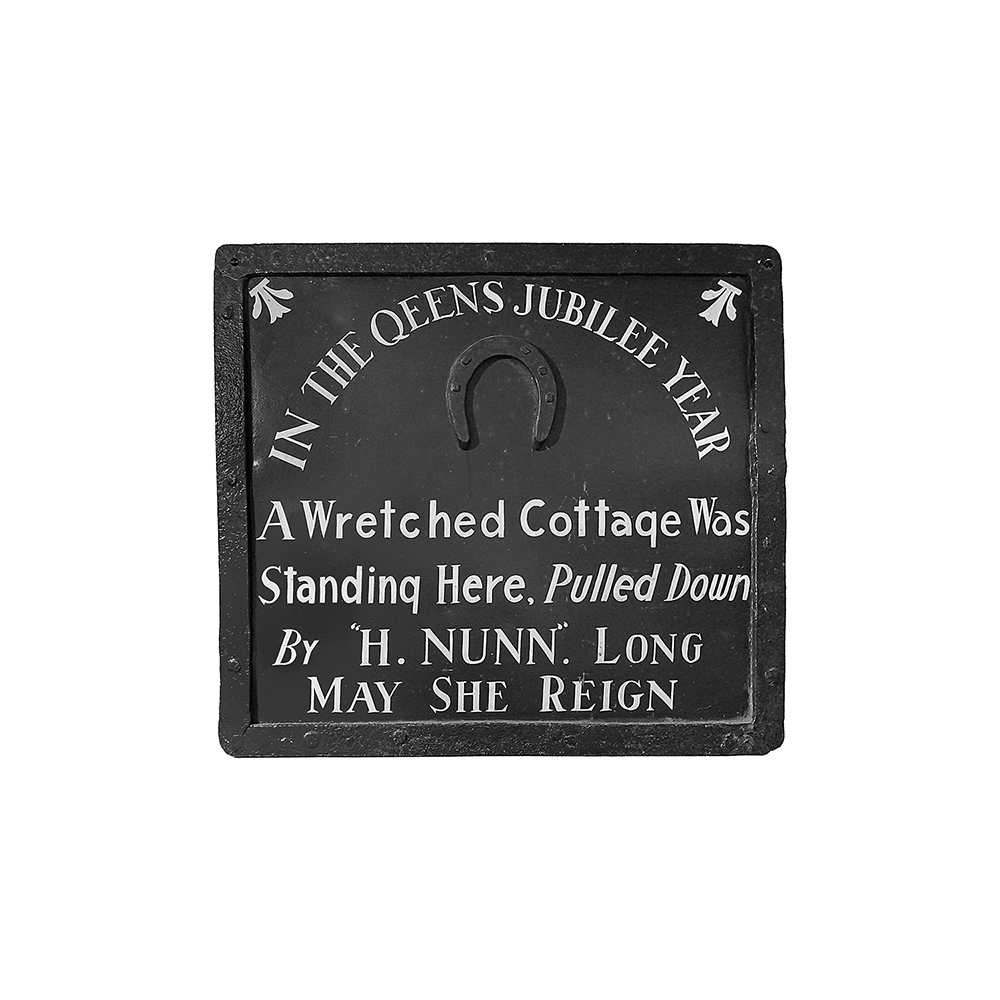
One building in particular drew his ire, a derelict cottage standing at the very gate of the church. He publicly condemned it as “an eyesore and a disgrace to the beautiful and sacred edifice” —and then, characteristically, decided words were not enough. Taking matters into his own hands and began systematically to demolish it.
An official warning from a solicitor acting for the Lord of the Manor failed to stop him but the showdown never came. Dick completed the job and tidied up the site.
To mark the moment, he fixed an iron sign to the neighbouring cottage, a defiant memorial that survives (now in the museum) to this day. It would not be his last act of direct action.
On Queen Street, another demolition was halted when Dick and his helpers were arrested, handcuffed, and locked up overnight in a Witham police cell. They were released without charge the next day and after touring the town from the back of a cart (to universal acclaim) he got back to work and finished the demolition.
On Grange Hill, matters went a step further. While dismantling yet another cottage, Dick was hauled down from the thatch and dispatched to Chelmsford Gaol. Along the route people stood at their gates and cheered as Dick passed by. He remained in gaol until a friend paid his bail. He was later bound over to keep the peace—a promise that sat somewhat uneasily with a man whose idea of civic duty involved a crowbar.
By the end of his campaign, Dick had demolished eight cottages in total, each condemned by him as “unfit to remain in existence.” It would have been ten but the owner of one on Grange Hill decided to demolish it himself before Dick had his chance and another owner of a cottage on the Earls Colne Road decided to renovate it before Dick’s promised demolition.
In Dick’s smithy, horses were always treated with respect and patience. So the sight of horses being whipped and straining to pull heavy loads up Coggeshall’s Grange Hill angered him deeply.
Dick did what he was supposed to do. He wrote to the authorities. He wrote to the newspapers. He argued that lowering the road surface at the top of the hill would make a big difference and would be ‘an easy job’. But nothing happened, the authorities had no mind to act.
So Dick took matters into his own hands. Gathering four labourers and enlisting a small army of local boys to run pails of water from the river to soften the road’s surface, he set to work with picks and shovels. By the time the authorities finally arrived—this time accompanied by the police—half the roadway had already been reduced.
Dick was ordered to stop, and reluctantly accepted, thinking that having finally turned up the authorities would now complete the job. In the event. The road was reinstated, they claimed it was ‘too complicated to lower it. The horses of Grange Hill continued to struggle—proof, to Dick at least, that sometimes the only way things changed was when someone simply started digging.
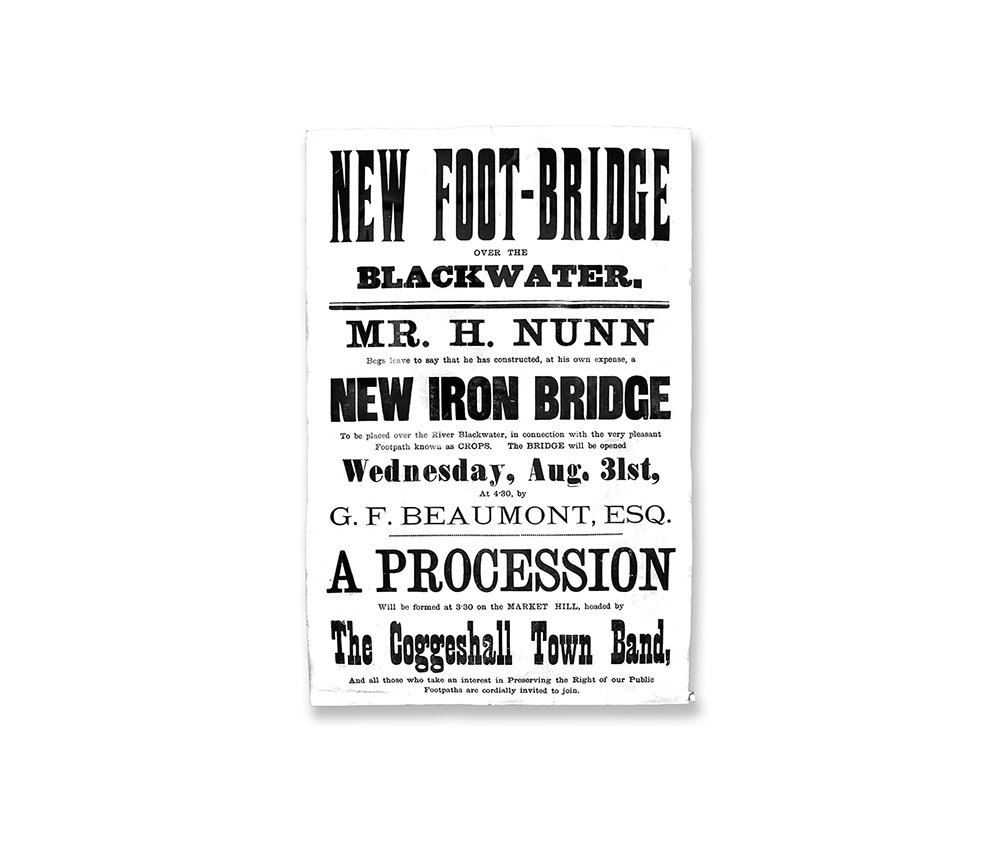
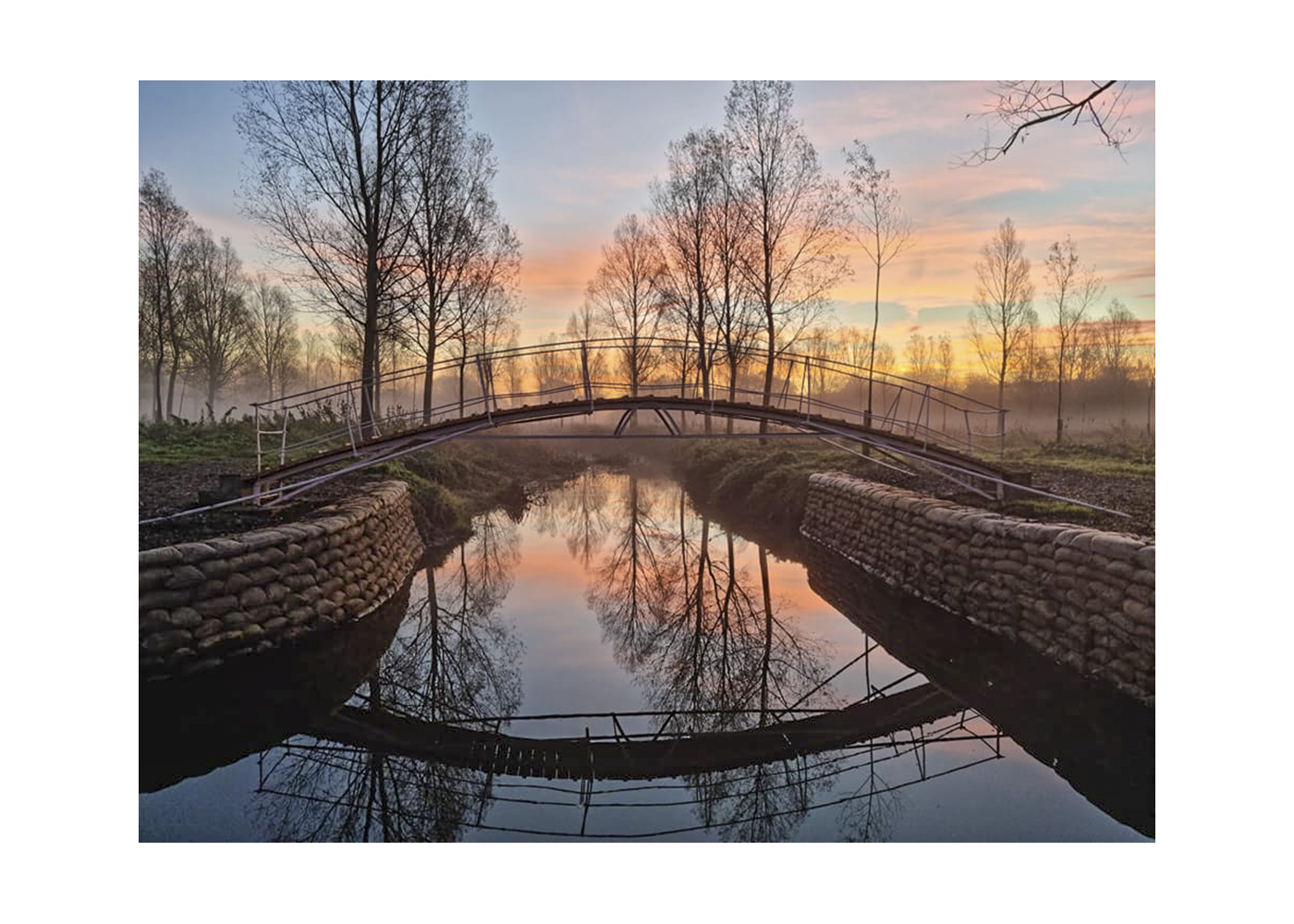
Dick was one of the earliest campaigners for public rights of way. He was determined to keep open the local paths and reopen those that had fallen into disuse. It was his efforts to reopen a path that led him to build the footbridge that to this day bears his name. When the old bridge collapsed in 1875 the path, much used by labourers and by courting couples, was closed and remained so for 17 years. Exasperated at the inaction, in 1892, Dick took matters into his own hands and set to work in his smithy to built a footbridge himself, using wrought iron which he then painted pink. The completed bridge was mounted on two trolleys and wheeled from his Swan Yard smithy and fixed into position over the river. The grand opening was advertised by a poster which Dick had printed and hundreds of people turned up. With the town band leading, they all made their way in procession to the bridge. Speeches were made and Mr George Beaumont then declared the bridge open and said from henceforth it would be called ‘Nunn’s Bridge’.
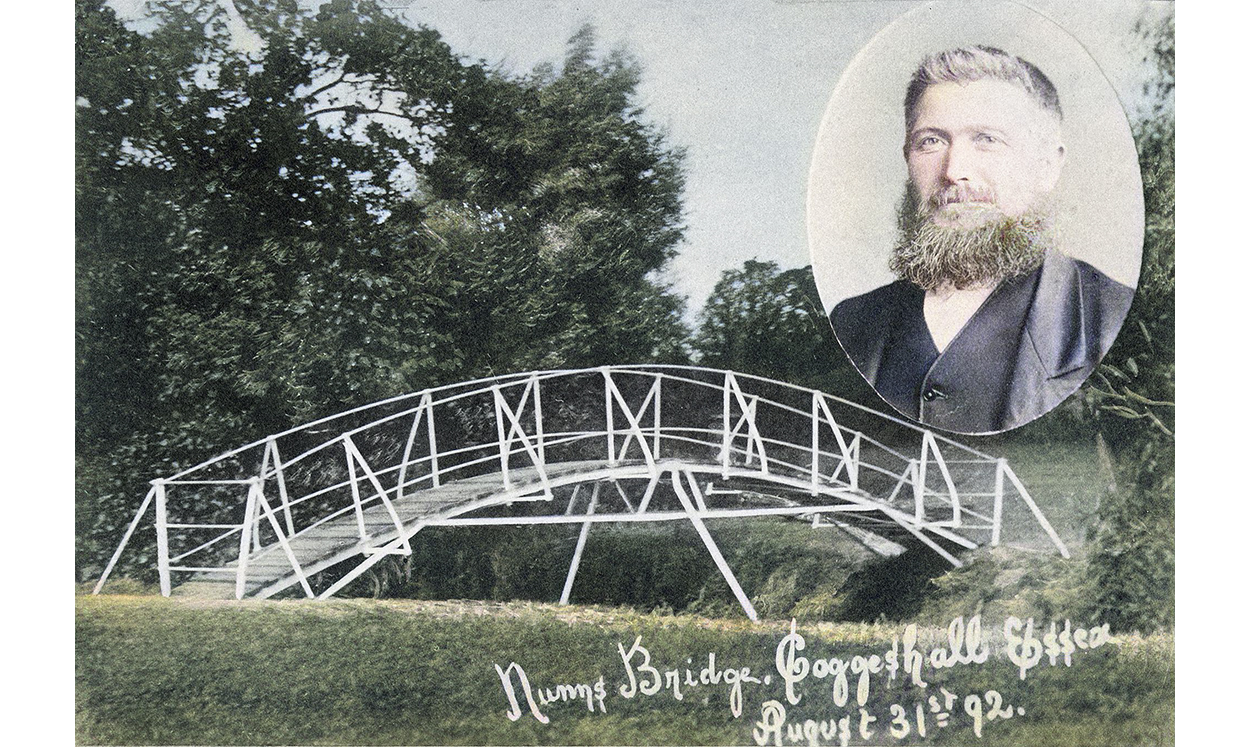
The crowd were invited to cross the bridge and pay a toll to help recompense Dick for the cost. Seven hundred and three people were counted over and a total of £12 15s. 5d. was collected, almost half the cost of the project.
In another case he advertised tin a local paper hat he was going to ‘trespass’ to re-open another footpath. The police attended and wrote down the names of those few people brave enough to follow Dick along the path. He told the policeman ‘Write my name down twice as I deserve it!’ The owner was incensed and held a shovel aginst Dick’s mouth to prevent further progress. Unpeturbed Dick asked him what he thought he was doing – and to be fair the chap had a sense of humour – ‘I’m digging for coal and you shall have the first that comes up!’ This led to another court case in front of a jury – mostly of farmers – but against the odds, Dick won the case, to the consternation of the judge, and the path was reopened.
Dick was regarded with great affection and when he died aged 60 in 1896, shops were closed and shuttered and hundreds of townspeople turned out to pay their respects at his funeral, following the town band to the church.
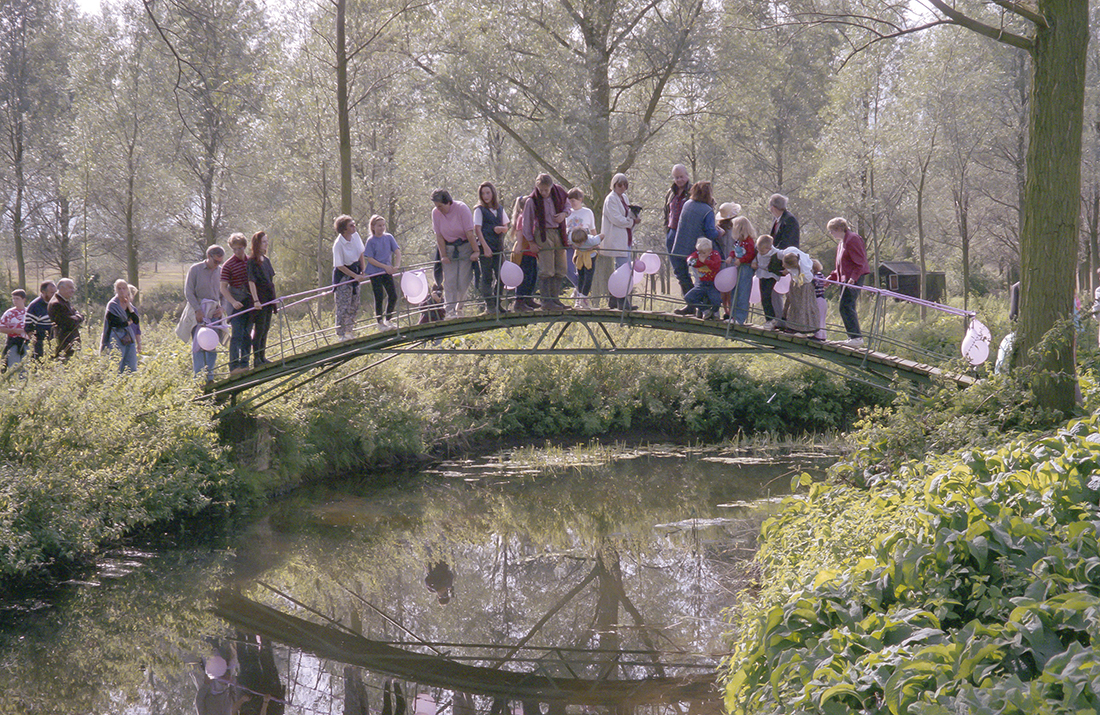
Dick and his bridge were never forgotten and the bridge has been repaired and repainted over the years. In the mid 1950s the bridge was in a desperate condition and seeral letters were sent by the parish council requesting repairs be made. They were but in 1957 the Essex County Council who then had care of the bridge were considering whether to restore or replace it. A letter from the parish council made it clear how much the bridge was special to the people of Coggeshall and should be restored. The District Surveyor responded sympathetically and finally in 1962 after 70 years the bridge was restored.
In 1992 the bridge’s centenary was marked with another procession from Market Hill down to the bridge which was decorated with pink crepe paper and pink balloons and speeches were once more heard in praise of our famous blacksmith.
In 2020 after the some of the timber decking fell into disrepair, Essex Highways, (who are now owners of the bridge by virtue of the public footpath which crosses it) made an inspection and concluded that the bridge was no longer fit for purpose and would be replaced. There was huge support from the Coggeshall community for restoration and there were some unsuccessful attempts to persuade Essex Highways to reconsider. This included a survey from one of the countries’ leading historic bridges experts which concluded that the bridge was basically sound. Then an application was made to Historic England to list the bridge and after a tense period of waiting the bridge was listed Grade II. Essex Highways then dropped plans to replace it and the bridge was subsequently restored and opened for use in October 2021.
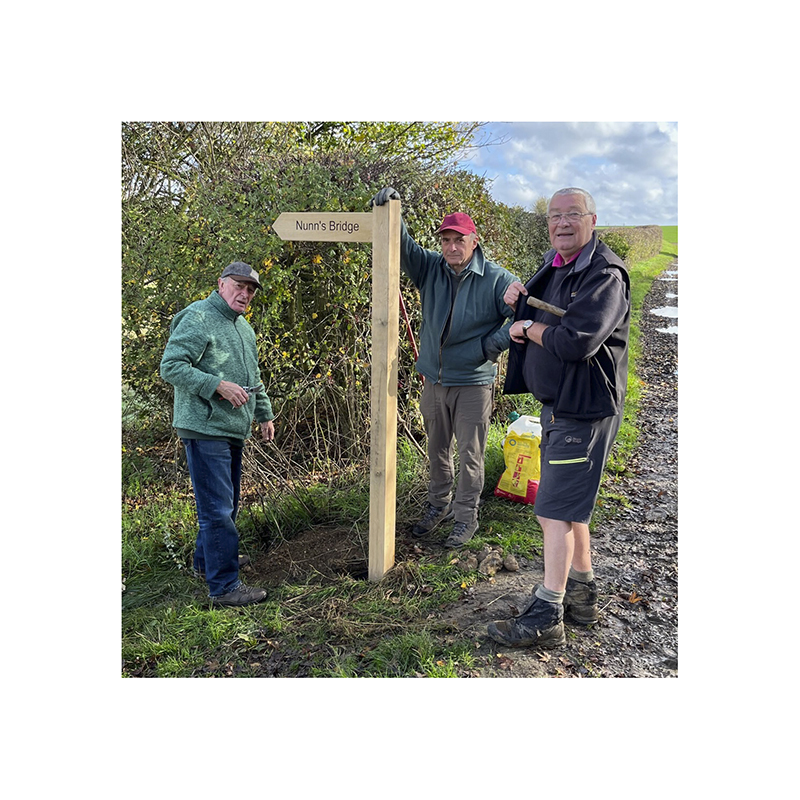
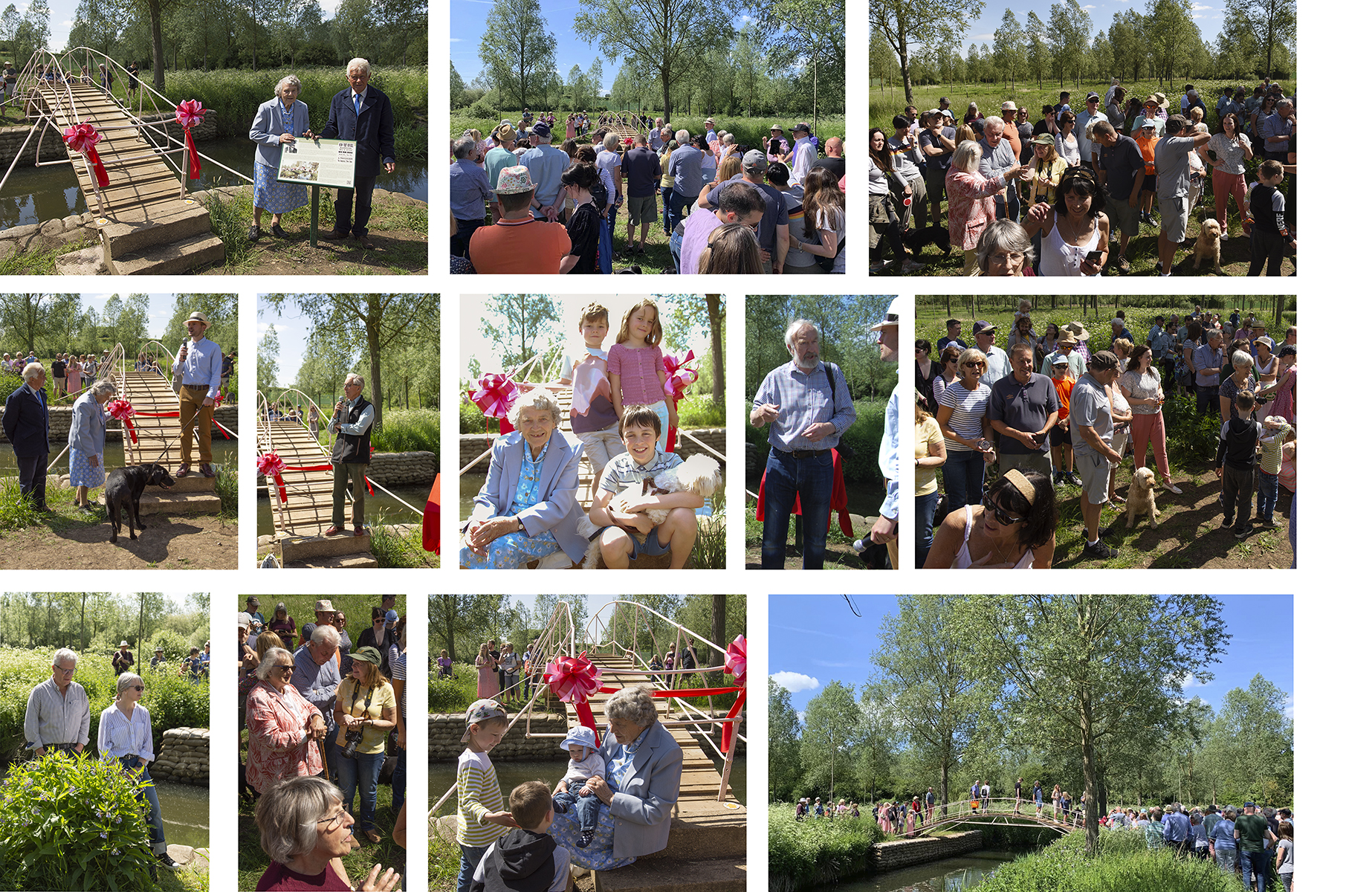
An official re-opening ceremony took place in the spring of 2022 on the 130th anniversary of the bridge’s construction and opening. An information board has been put up next to the bridge which tells something of Dick Nunn and the how the bridge came to be made. The bridge was declared officially reopened by two long-term Coggeshall residents, Bruce Northrupp and Josie Martin with a sizeable crowd of enthusiastic locals adding their support. With all the publicity the bridge is busier than ever helped also by the two new oak fingerposts, one on the West Street end of the path and the other on the Essex Way. Both these and the information board were funded locally.
The museum has a display devoted to Dick Nunn which includes the old iron sign and one of the original posters.