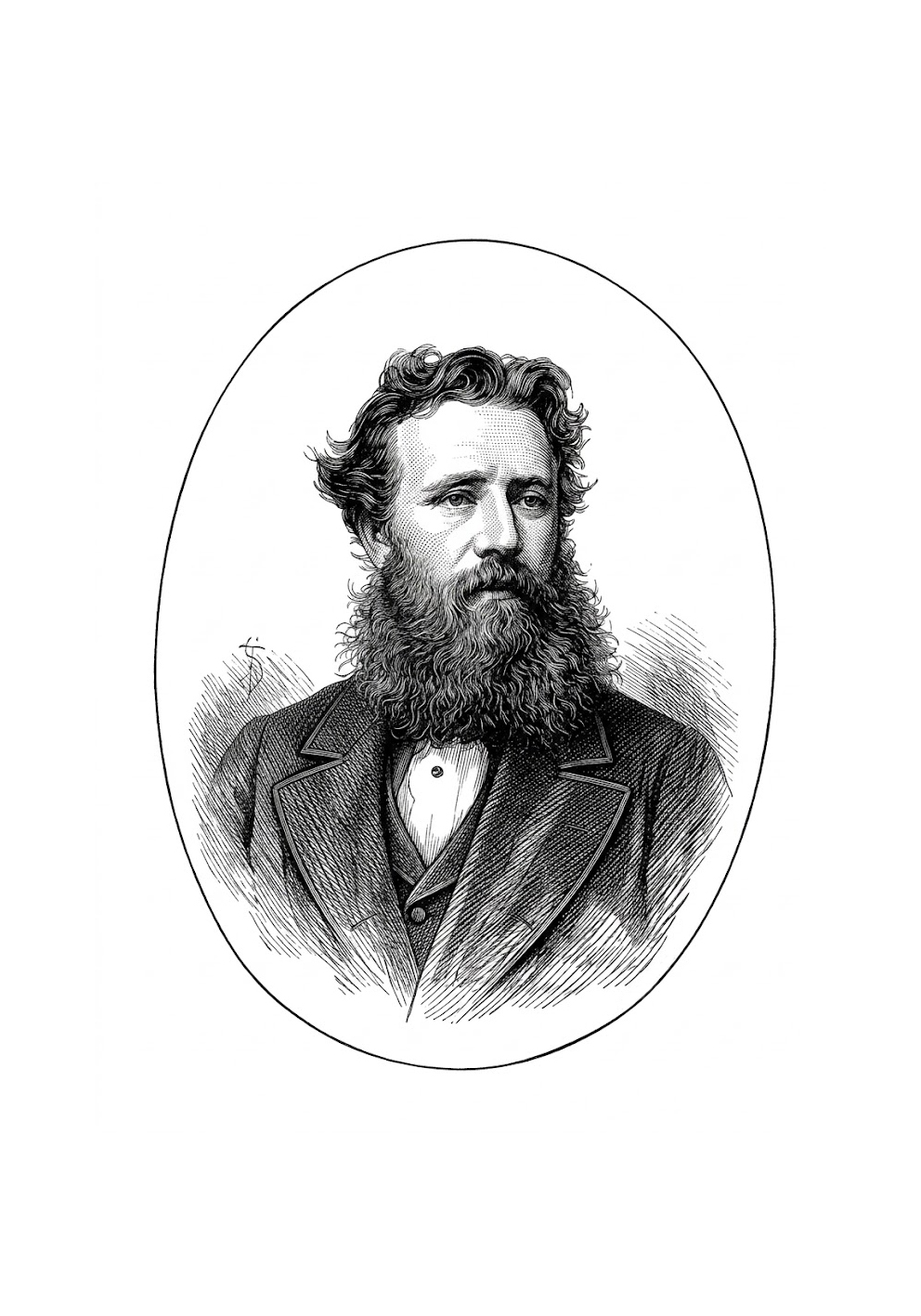
Charles Edward Smith (1837–1879), born in Coggeshall, was a Quaker, physician, Arctic surgeon, naturalist and colonial practitioner whose short life was marked by extraordinary variety and adventure.
From childhood, Smith displayed an intense interest in natural history, particularly birds. By the age of nine he was writing his own natural-history manuscript, and as a young teenager he was observing birds, collecting specimens and giving illustrated lectures on insects. His enthusiasm continued at the Quaker Boarding School at Ackworth in Yorkshire where his bedroom was reportedly filled with natural-history specimens. He also became acquainted with the celebrated naturalist Charles Waterton. These early interests remained a constant throughout his life.
After a brief and unsuccessful period as a teacher, Smith turned to medicine, studying initially in London and then at the University of Edinburgh from 1861 to 1864, where he was a student of Professor John Goodsir. He was remembered by his fellow student J. Milner Fothergill as intelligent, humorous and unconventional. Smith sometimes preferred exploring the countryside and studying natural history to attending lectures, earning from some professors the description of a “black sheep”. His apparent irreverence, however, concealed a highly observant and enquiring mind.
Financial necessity led Smith to accept an appointment as surgeon aboard the Hull whaler Diana in 1866. This became the defining episode of his life. The vessel was trapped in Arctic ice from August 1866 until the following spring, leaving the crew facing prolonged cold, starvation, scurvy and disease. Captain John Gravill died, followed by many members of the crew. Smith himself became seriously ill but continued treating the sick, helping to operate the ship and working at the pumps.
When the Diana finally reached Shetland in April 1867, fourteen men had died. Smith’s conduct attracted widespread admiration. The Board of Trade, Hull medical profession, merchants and underwriters all honoured him for his courage, humanity and professional skill. He received testimonials, money, surgical instruments and other presentations. The British Medical Journal later described his life simply as “A Life of Heroism.”
Smith subsequently presented his Arctic medical observations to the Edinburgh Obstetrical Society in 1868. His paper discussed both Inuit practices and the effects of prolonged cold, hunger and exposure on the human body.
After another Arctic expedition, Smith returned to Britain and worked in a succession of medical positions, including among railway navvies near Carlisle, with Dr Paul Moffatt at Dalston, at Glasgow Royal Infirmary and in Durham. His career was characterised by movement, but he gradually acquired his professional qualifications, becoming a Licentiate of the Royal College of Surgeons of Edinburgh in 1872 and subsequently holding the Edinburgh medical and midwifery qualifications he later declared in New Zealand.
In the early 1870s Smith emigrated to New Zealand, serving as surgeon aboard the emigrant ship Dunedin. He settled at Otepopo in Otago, where he acquired a medical practice and finally achieved some stability. He travelled great distances to visit patients, sometimes forty or fifty miles, and became highly regarded within the local community. He was appointed Public Vaccinator and later served as a Justice of the Peace. He also married Grace Elizabeth Summerell in 1876 and established a home surrounded by English plants and fruit trees. Their infant son, Frederic Henry, died in January 1879.
Otepopo also allowed Smith’s interest in natural history to flourish. In 1877 he wrote a substantial article, “The Shooting Season,” describing the birds, fish and wildlife of the district. Although interested in shooting, he strongly criticised the needless destruction of rare species and objected particularly to collectors who killed wildlife in the name of science.
Smith’s interests extended beyond natural history. In 1878, through his brother-in-law James Hurnard in Essex, he helped arrange the transfer of a collection of Roman antiquities from the Colchester area to the museum at Dunedin. The collection included pottery, cinerary urns, Roman glass, lamps and numerous coins. Smith’s significance was as the intermediary linking his native Essex with New Zealand.
By 1879 Smith’s health had deteriorated, probably exacerbated by the demands of his extensive rural practice. He abandoned his Otepopo practice and returned to Britain, hoping that rest and the sea voyage would restore him. His condition continued to worsen. He was treated in London by, among others, his old Edinburgh friend J. Milner Fothergill, and eventually returned to his father’s home at Kelvedon.
Charles Edward Smith died there on 6 September 1879, aged only forty-one. He was buried at the Society of Friends’ burial ground at Coggeshall on 11 September, returning him to the Quaker community and Essex landscape in which his life had begun.
His reputation survived through several different forms. His brother-in-law James Hurnard commemorated him in poetry as “Our Charlie”, recalling both his care of the sick and his work at the Diana’s pumps. A memorial connected with the Diana was unveiled at Lerwick in 1890. Fothergill’s memoir, Diana Smith, preserved memories of Smith’s personality, humour and natural-history interests, while his Arctic diary was eventually published in 1922 as From the Deep of the Sea. The original manuscript survives in the Hull Museums Collections.
In essence, Charles Edward Smith was an adventurous and unusually observant nineteenth-century doctor whose life combined medicine, natural history, exploration and public service. His early fascination with the natural world accompanied him from Coggeshall to Edinburgh, the Arctic and finally New Zealand. His greatest distinction may therefore be summed up in the closing thought of the original account: the student who sometimes preferred to leave the lecture room to observe the world ultimately made the world itself his classroom.
This is a summary of a much more detailed account of the life of Dr Smith by Michael Tracy which can be read here