SILK
By 1815 the woollen industry had all but disappeared and Coggeshall, which had grown prosperous on the back of the trade during the previous four centuries, suddenly found itself facing economic decline. During the first years of the 19th century the situation was further compounded by weavers who had joined the army for lack of work returning from the war with France to become unemployed once again.
In 1766 legislation had been brought in which prohibited the importation of foreign silks and velvetsallowing the British silk industry the scope to develop free from foreign competition. Some of the old woollen clothiers began to weave silk on a small-scale basis – Johnson, the last of this generation, was manufacturing shalloon at “Monkwell” by 1827.
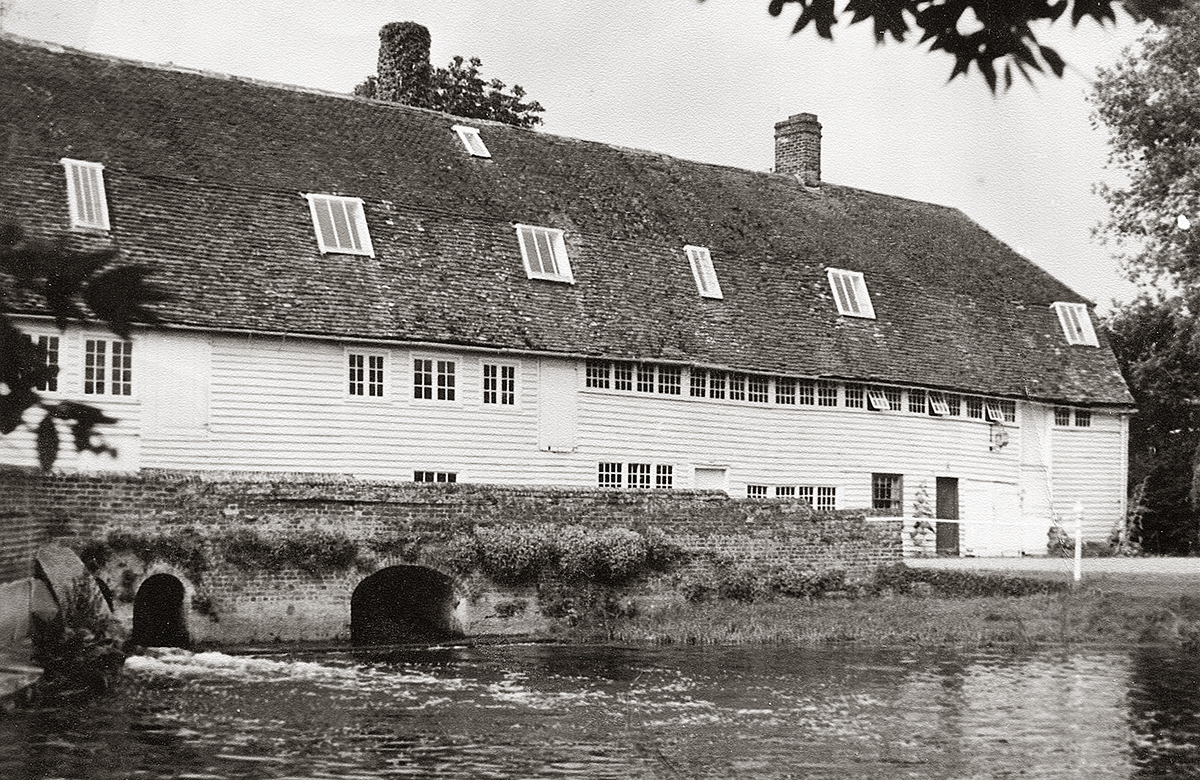
In 1818 John Hall from the established Coventry firm of Sawyer & Hall set up a branch of his silk-ribbon making business in Coggeshall. He took a twenty year lease on the Abbey water mill and after consulting George Courtauld on ideas for the interior design he converted it for silk throwing in 1820 and by 1838 it was working with an 8hp water wheel and a 10hp steam engine. Hall commented, ‘Previous to our establishing the silk-mill the parish was deeply in debt, the poor children in rags, miserable looking wretches, more like an Irish than an English village.’
Hall was not alone, from 1819 until 1824 a certain Richard Smith was throwing silk in Coggeshall on a fairly large scale.
Silk throwing or throwsting is the process of spinning several individual strands of silk together to produce a usable thread. The number of strands and hence the thickness of the thread produced depended on the intended use and was measured in Deniers.
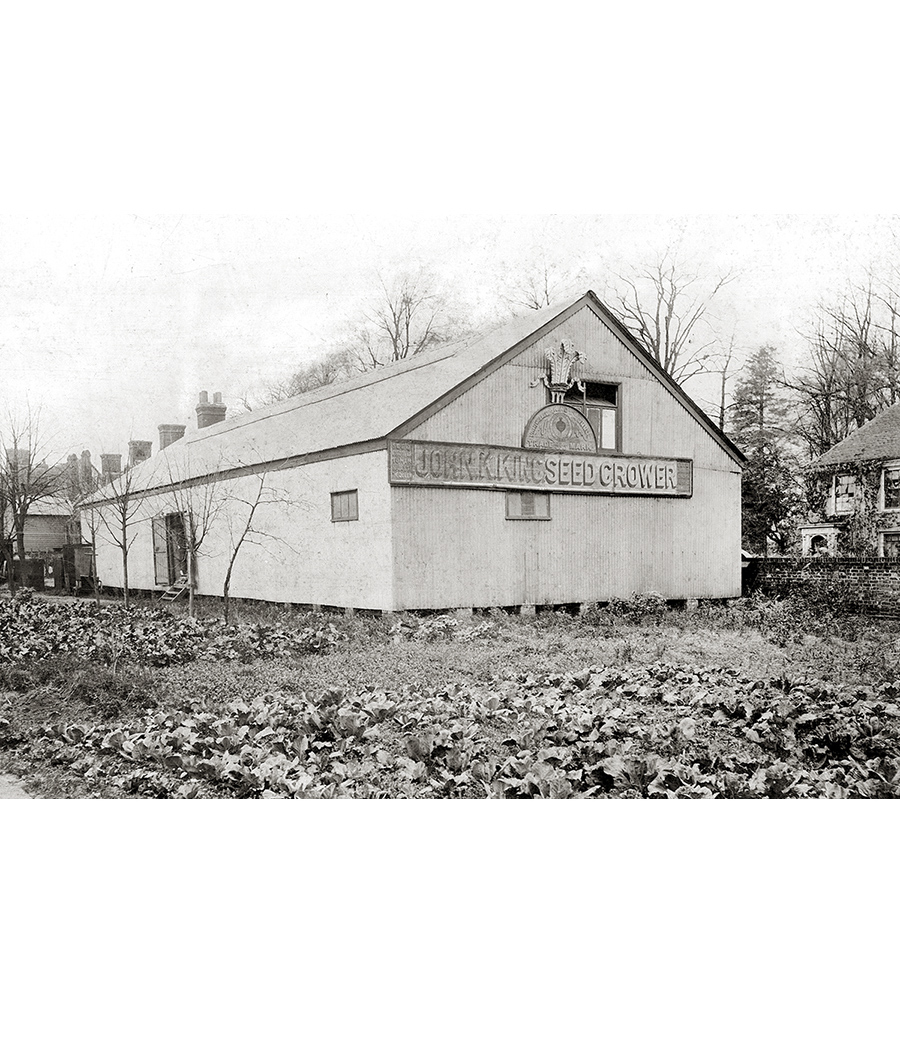
Hall also leased an old factory on the Gravel in Coggeshall. This factory, 130 ft x 24 ft in area, stood across Robin’s Brook on the south side of Hares Bridge, West Street and housed 30 rack and pinion power looms and some broad looms on the first floor which had good lighting from skylights. Hall owned a total of about 70 broad looms, the remainder of which were kept by his workers in their cottages. On the ground floor of the Gravel Factory children were employed in a silk throwing, winding silk and preparing it for the market. These children commenced work as half-timers at the age of eight years spending half a day in the factory and half a day at school.
The photo shows the Gravel Factory as it appeared much later after JK King restored it as a warehouse. King seems to have encased the building in corrugated sheeting. The building can be placed because the house on the right still exists next to Hares Bridge on West Street.
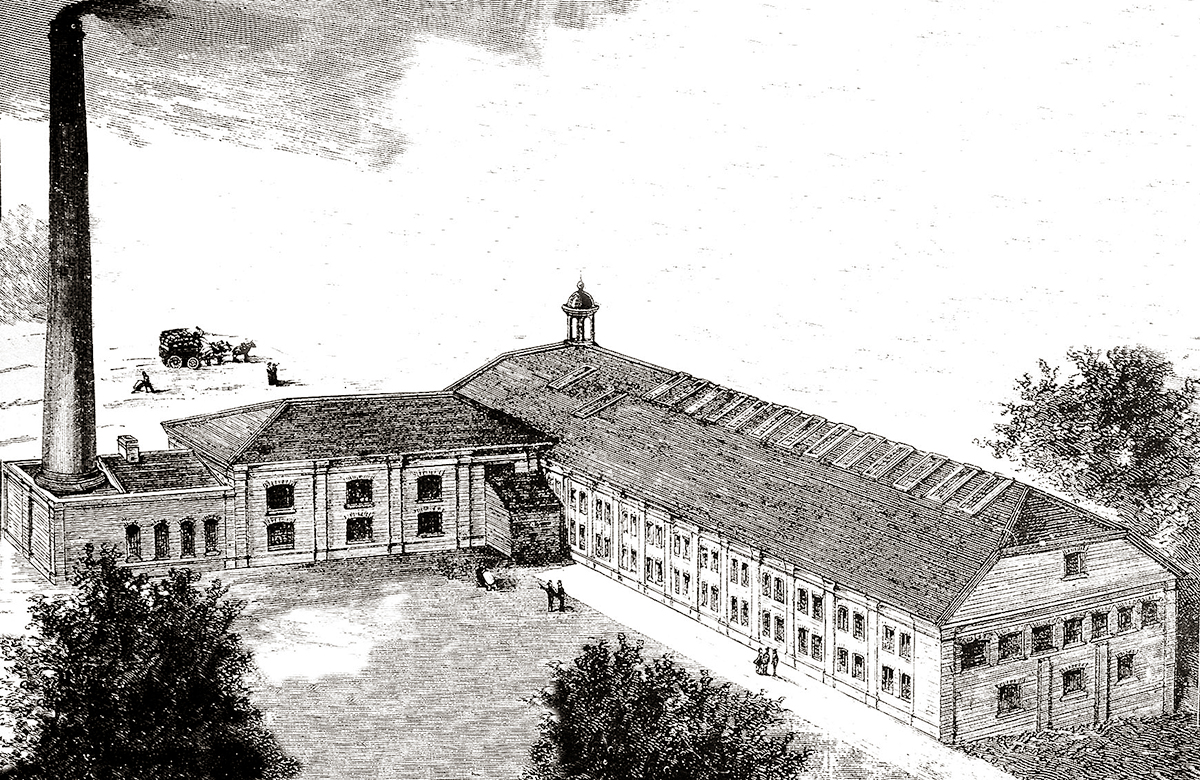
The business must have been profitable because in 1834 Hall decided to purchase land on the opposite side of West Street and build a brand-new factory abutting the existing Orchard House. A three-storey building (some sources say two), and powered entirely by steam, it was probably entirely used for silk throwsting mostly carried out by children and opened in 1839. Some reports suggest that weaving was carried out on the upper floor but this has not been confirmed.
Hall always had problems in finding workers for his Orchard Mill – largely because it was considered by the locals to be to be a place of coarse language and manners. They also had the option of employment in the making of tambour lace which did not have the same reputation for immorality. Hall claimed that his problem was due to the fact that his industry was regulated under the Factory Act whereas tambour lace making, largely a domestic industry, was not.
In 1841 one third of Hall’s machines stood idle due to lack of workers and it meant that further expansion in Coggeshall was impossible. Out of desperation, Hall imported 35 girls aged 11 to 16 to work as winders. They were lodged in a hostel supervised by a domestic superintendent. These cottages in Crouches and Stoneham Street he also let to his weavers for 2/- (10p) per week.
Hall became an integral part of local economic life. The 1851 Census identified him providing employment for 419 people – men, boys, and females between the ages of nine and 18, who were mostly the daughters of labourers. They would have bound themselves to John Hall for three years, working 11 hours a day, six days a week. The average wage, depending on age, was 3 shillings (15p). Although Hall was active in local politics and in church affairs, his interests were often compromised as the Vicar was trying to establish a National School. By 1855 an arrangement must have been reached as children starting work for him, aged eight, were known as “half-timers”; half their day spent in the silk mill, the other half at school.
In the 1850s from factory and cottage, the rattle and hum of five hundred looms, busy in the manufacture of velvet, was to be heard in Coggeshall.
Price fixing in the Spitalfields silk-makers led to a migration to Coggeshall where wages were a third lower. By 1827 Beckwith was manufacturing in Back Lane in Coggeshall, in addition to his premises at Spital Square, London.15 Thomas Westmacott of 8 Noble Street, London, had a factory in on Church Street and later Benjamin Wilson of 37 Wallbrook and Thomas Brooks of 26 Spital Square. a Mr Goodson had his business making silk plush for hats next to the river at ‘Monkwell’ on Grange Hill. At one time there were seven silk masters in the town , some like like Mr Brooks, Mr Soper Mr Spurge and Mr Walters would supply materials for weavers to work in their own homes which many weavers preferred.
Hall made it quite clear in 1832 that he was getting his labour much more cheaply than were his counterparts in either Coventry or Spitalfields,20 but such disparity was not surprising considering the wage reductions he imposed. The silk trade in general experienced difficulties in the years immediately following 1826, when the total prohibition on the importation of foreign silks and velvets was removed, but the measures then taken by the Coggeshall manufacturers often verged on the extreme. Hall lowered his wages by 20% between 1830 and 1832,21 yet his reduction was relatively moderate compared with that of Beckwith, who in 1832 had enforced wage reductions as great as 60% during the previous four years.22 Such alterations would probably have been impossible in Coventry where, because of the greater solidarity of the employees, strike action would have resulted. That is not to say that the Coggeshall workers did not show their resentment, but rather that they lacked the organisation and genuine hostility to disturb the manufacturing interests.